

What is residual income? At its simplest, it’s the amount of money left over after the relevant costs have been subtracted from income. That definition sounds straightforward, but the confusing part is that “relevant costs” means something different depending on who’s asking. A household budgeter, a corporate accountant, and an equity analyst all use the term “residual income,” and all three are calculating something slightly different.
In personal finance, residual income can refer to the money left after regular expenses and debt obligations are accounted for. Some sources use the term similarly to discretionary income, although the definitions are not always identical. In managerial accounting, it’s a performance measure that compares a business unit’s profit against the minimum return required on the capital it uses. In equity valuation, it feeds into a model that estimates what a company’s stock is actually worth. This article walks through all three, gives you the formulas and worked examples for each, and separates the concept from the unrelated (but related-sounding) idea of passive income.
What Is Residual Income?
Residual income is money that remains after subtracting whatever costs are relevant to the specific context you’re measuring it in. That’s the umbrella definition. The reason it doesn’t have one universal formula is that “cost” changes meaning depending on the field.
- In personal finance, the relevant costs are living expenses and debt payments, and residual income means the cash you have left.
- In corporate and managerial accounting, the relevant cost is a capital charge, an internally required rate of return applied to the assets a division or project uses. Residual income here shows whether that unit generated profit above what was required to justify using that capital.
- In equity valuation, the relevant cost is the cost of equity capital, and residual income becomes a building block in a model used to estimate a stock’s intrinsic value.
Each version answers a genuinely different question, even though all three trace back to the same root idea: income minus a required deduction equals what’s left.
Residual Income Meaning in Different Contexts
Residual Income in Personal Finance
Say you bring home $5,000 this month. Rent, food, utilities, debt payments — all that eats up $3,800. What’s left over, $1,200, is what everyday personal finance language calls residual income, and people often use it interchangeably with discretionary income. Lenders care about this number specifically because it tells them whether a borrower can actually handle a new monthly payment on top of what they’re already paying, which is exactly why the term comes up so much in mortgage and loan underwriting.

The simplified formula:
Residual Income = Total Income − Living Expenses − Debt Payments
This use of the term isn’t identical across every source. Some define it strictly as leftover cash after fixed obligations; others fold in more categories of spending. Treat it as an approximate, practical figure rather than a precisely standardized one.
Residual Income in Accounting
In accounting, the calculation changes entirely. Here, residual income is a performance metric used to evaluate whether a business unit, division, or investment earned more than the minimum return required to justify the capital tied up in it.
Residual Income = Operating Income − (Operating Assets × Required Rate of Return)
A positive number means the division generated profit beyond what was required. A negative number means it didn’t clear that bar, even if it was technically profitable on paper.
Residual Income in Equity Valuation
This is exactly where “residual income model” trips people up, because it sounds like it should mean some kind of recurring cash flow for an investor. It doesn’t. In equity valuation, residual income actually means a company’s net income after you subtract a charge for the cost of equity capital, not just debt. Analysts use the Residual Income Model (RIM) to work out a company’s intrinsic share value based on that adjusted number. This approach is formally documented as an equity valuation method that factors in the cost of equity capital, which is what sets it apart from plain net income.
What Is the Residual Income Formula?
Because the meaning shifts by context, so does the formula. Don’t mix these up.
Personal finance: Residual Income = Total Income − Expenses − Debt Payments
Corporate/accounting: Residual Income = Operating Income − (Operating Assets × Required Rate of Return)
In the accounting version, “operating income” is the profit generated before financing costs and taxes, “operating assets” is the capital base the unit is using, and the “required rate of return” is the minimum return management or the parent company expects on that capital, often tied to the company’s cost of capital.
How to Calculate Residual Income

A worked example makes this concrete. Suppose a business division reports:
- Operating income: $250,000
- Operating assets: $1,000,000
- Required rate of return: 10%
First, calculate the required return in dollar terms:
$1,000,000 × 10% = $100,000
Then subtract that from operating income:
$250,000 − $100,000 = $150,000 residual income
A positive residual income of $150,000 means the division generated operating income above the minimum return expected on the assets it used. If the same division had only generated $80,000 in operating income against that same $100,000 required return, its residual income would be negative $20,000, meaning it technically failed to earn back the cost of the capital tied up in it, even though it was still profitable in an accounting sense.
Residual Income Examples
Example 1: Personal finance. $4,000 in monthly income minus $3,000 in rent, groceries, and loan payments leaves $1,000 in residual income.
Example 2: Business division. Using the figures above, $250,000 operating income against a $100,000 required return produces $150,000 in residual income.
Example 3: Investment valuation. A company reports $2 million in net income. Its cost of equity capital for the period, calculated against its book value of equity, works out to $1.6 million. Residual income for valuation purposes is $400,000, the portion of net income that exceeds what shareholders required as compensation for their capital. Analysts would use a projection of figures like this, discounted back to the present, as an input into the residual income model.
What Is the Residual Income Model?
The Residual Income Model (RIM) is an equity valuation approach built on the idea that a company’s intrinsic share value equals its current book value of equity plus the present value of all expected future residual income. Conceptually:
Equity Value = Current Book Value of Equity + Present Value of Expected Future Residual Income
Rather than projecting dividends or free cash flow the way other valuation models do, RIM starts from a company’s book value and adjusts it for how much profit the company is expected to generate above its cost of equity going forward. It’s frequently used for companies that don’t pay dividends or that have unpredictable cash flow, since dividend-based models struggle with those cases. This is a distinct concept from the personal-finance or accounting versions of residual income covered above; it’s a valuation technique, not a household budget figure or an internal performance score.
For What Purpose Do Companies Calculate Residual Income?
Companies mainly calculate residual income to check whether a business unit, division, or investment is actually making more than the minimum return required for the capital it’s using. Net income or operating income can look perfectly fine on paper while still not justifying the capital sitting behind it, and residual income is one of the ways accountants and managers spot that gap.
Beyond that main purpose, the metric feeds into a few other decisions too. It helps compare performance across divisions of different sizes, since unlike a plain profit number, it accounts for how much capital each division actually used. It informs decisions about where to allocate more capital going forward. And it gives management a number that’s harder to manipulate than simple profit growth, since padding profit with capital that doesn’t pull its weight actually drags residual income down instead of up.
Why Is Residual Income Important?
Residual income matters because it draws a line between accounting profit and real economic performance. A division could show rising profits year after year while still quietly destroying value, if that growth comes from tying up more and more capital that isn’t earning a decent return. Residual income catches that in a way raw profit numbers just don’t.
It also plays into capital allocation. A company weighing several internal projects or divisions can use residual income to see which ones are genuinely creating value relative to what they cost to run, rather than just which one reports the biggest profit figure. That said, it’s not automatically the best measure for everything. ROI and other ratios still have their place, especially when you’re comparing units of very different sizes on a percentage basis instead of a raw dollar basis.
Positive vs Negative Residual Income
| Result | Meaning |
|---|---|
| Positive | Income exceeds the required return or cost used in the calculation |
| Zero | Income exactly meets the required return |
| Negative | Income falls below the required return |
A positive number is generally read as value creation. A negative number doesn’t necessarily mean a division is unprofitable in an absolute sense, only that it didn’t clear the specific bar set by the required rate of return used in that calculation.
Residual Income vs Passive Income
These two terms get used almost interchangeably in casual conversation, and that’s part of where the confusion comes from. Passive income generally refers to income generated with limited ongoing active involvement, things like rental income, royalties, dividend income, or recurring commissions that keep paying out after the initial work is done.
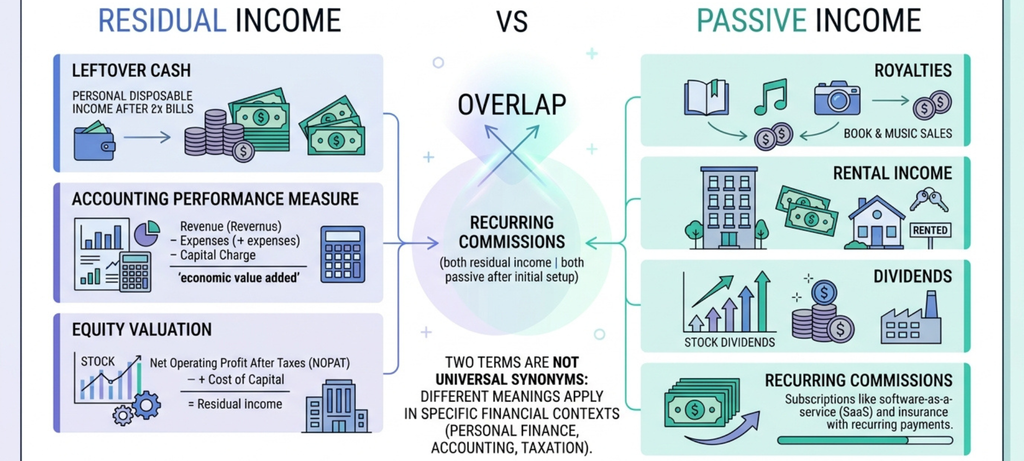
Residual income does not always mean recurring income, though. In personal finance and accounting, it refers to what remains after a specified deduction or required return, not to how the income arrives over time. In sales and other everyday business contexts, “residual income” is often used loosely for recurring commissions that continue after the original sale, which is closer to what most people mean by passive income.
They genuinely overlap in that everyday usage. Recurring commission structures are a good real-world example of where the two ideas blend: some sales arrangements pay an agent repeatedly for as long as the underlying account stays active, which is recurring in the everyday sense but isn’t the same calculation as the accounting or valuation definitions covered earlier in this article.
How Can You Make Residual Income?
In the everyday sense, the one people mean when they talk about recurring income, there are a handful of realistic ways to get there. None of them just happen on their own from day one, though. Royalties and licensing pay out again and again once some creative or intellectual work gets published and starts selling, but you still have to put in the upfront work of actually creating something people want to license first. Rental income shows up every month too, but it takes capital to buy the property in the first place, plus either ongoing management or paying someone else to handle that for you. Digital products, subscription businesses, affiliate income, they all follow roughly the same pattern: build it once, then keep maintaining and marketing it so the money keeps coming in.
Recurring sales commissions work a bit differently. A salesperson keeps earning a share of revenue from an account they originally signed, instead of getting one lump payment and being done with it. None of this is really “passive income while you sleep” the way it gets sold online. Most of these paths need real upfront effort, real capital, or at least some ongoing light management to keep the income actually flowing.
Residual Income in Sales and Commissions
Some sales arrangements provide recurring commissions for as long as a customer or account remains active, rather than a single flat payment at the time of sale. This is a different use of “residual income” again, closer to the everyday, recurring-income meaning than the accounting formula covered earlier.
Merchant services and payment processing are a commonly cited example of this structure, where an agent signs a merchant once and may continue earning a share of that account’s processing revenue for as long as the merchant keeps using the service and the underlying agreement stays in force. If you want the mechanics of how that specific model works, including how buy rates and markups actually determine what an agent is paid, see this breakdown of how credit card processing residual income works.
Residual Income in VA Loans
Residual income has a separate, specialized meaning in VA loan underwriting, and it shouldn’t be confused with the accounting or valuation definitions above. In that context, lenders use residual income requirements to evaluate whether a borrower has enough money left over each month, after the mortgage payment, taxes, insurance, and other debts, to cover ordinary living expenses. The Code of Federal Regulations sets out how VA lenders are required to calculate and apply this residual income test as part of loan underwriting. The required minimum varies by region and household size rather than being a single fixed number. That calculation is a distinct underwriting concept from the accounting formula discussed earlier in this article, so treat it as its own topic rather than an application of the same math.
Common Mistakes When Understanding Residual Income
A few misunderstandings come up repeatedly. People often assume residual income always means passive income, when in most financial and accounting contexts it doesn’t refer to passivity at all, just to what’s left after a specific deduction. Others apply the personal-finance formula in a business context, or the reverse, which produces numbers that don’t mean what they think they mean. It’s also easy to confuse residual income with net income or with cash flow; residual income is neither of those on its own; it’s a comparison between income and a required return or set of costs, not a raw total. On the accounting side, a common error is calculating operating income correctly but forgetting to apply the required rate of return to the actual capital base, which quietly changes the result. Finally, some people treat the residual income model (equity valuation) as if it were the same thing as recurring income from a job or a sales role, or treat VA residual income as identical to the accounting formula, when both are separate, specialized applications of a shared term.
Frequently Asked Questions
What is residual income?
It’s the amount of money left after subtracting the relevant costs from income, with the exact meaning depending on context: money left after expenses in personal finance, profit above a required return in accounting, or income above the cost of equity in valuation.
What does residual income mean?
In its broadest sense, it means what remains after a required deduction has been subtracted from income, whether that deduction is personal expenses, a capital charge, or a cost-of-equity charge.
What is the residual income formula?
There are two main formulas: personal finance uses total income minus expenses and debt payments, while corporate accounting uses operating income minus operating assets multiplied by the required rate of return.
How do you calculate residual income?
Identify the relevant income figure and the relevant deduction for your context, then subtract one from the other; for a business division, that means subtracting the dollar value of the required return (assets times required rate) from operating income.
How do you find residual income?
The same process as calculating it: determine which context applies (personal, accounting, or valuation), gather the relevant income and cost figures, and apply the matching formula.
What is residual income in accounting?
It’s a performance measure equal to operating income minus a capital charge, used to show whether a division or investment earned more than the minimum return required on the capital it used.
What is the residual income model?
It’s an equity valuation approach that estimates a company’s intrinsic share value as its current book value of equity plus the present value of its expected future residual income.
For what purpose do companies calculate residual income?
Primarily to see whether a business unit or investment is creating value above its cost of capital, which supports performance evaluation, comparisons across divisions, and capital allocation decisions.
What is the difference between residual income and passive income?
Residual income is a broader term whose meaning shifts by context (leftover cash, accounting profit above a required return, or valuation input), while passive income specifically describes earnings that require limited ongoing active involvement; the two overlap in everyday usage but aren’t strict synonyms.
What are some residual income examples?
Leftover monthly cash after expenses (personal finance), a division’s operating income above its required return (accounting), and net income above a cost-of-equity charge (valuation) are three concrete examples covered in this article.
How can you make residual income?
Common paths include royalties and licensing, rental income, digital products, recurring sales commissions, and subscription-based businesses, most of which require meaningful upfront work or capital before they start paying out.
What is VA residual income?
A specialized underwriting requirement used for VA home loans that measures whether a borrower has enough money left over monthly, after housing costs and debts, to cover living expenses; it’s calculated differently from the accounting version of residual income and varies by region and household size.
Final Thought
If you’re still wondering what is residual income, the simplest answer is that it describes what remains after the relevant costs or required return are taken into account. The exact meaning depends on the context. In personal finance, it can mean money left after expenses and debt payments. In accounting, it measures profit above a required return on assets. In equity valuation, it helps estimate value based on income above the cost of equity. Once you identify which definition applies, the right formula becomes much easier to understand and use.